Pages

Showing posts with label Christianity. Show all posts

Thursday, 23 February 2012

Up and away with #BigRead12

A couple of days into Lent, and our family is already getting its teeth into Mark's gospel courtesy of Tom Wright's 'Lent for Everyone - Mark' and the Big Bible Project's #BigRead12 initiative.

It's a great feeling to be part of a loosely-connected group of people studying the same text at the same time. Fantastic to do a Google search for #bigread12 and read what others are writing. But most of all, it's marvellous to have a ready-made opportunity to study and reflect on a text which we've all read before in short passages hundreds of times, but in our case, certainly, never approached as a whole.

I've had a copy of Tom Wright's 'New Testament for Everyone' since it was published last year, and although I've referred to it a few times to get Tom's take on the occasional passage, I haven't embarked on a proper read of it. I'm delighted to have the chance to do that now. His translation is fascinating - it really pulls the reader into the text, using modern English phraseology but staying very close to a literal translation. It's a very easy read which the whole family can understand without being dumbed-down or straying way off-piste.

Tom's introductory video to this week's passages described Mark's account as 'breathless' - I can see what he means by that. So much happens in Mark 1 - we get all the way from John the Baptist through Christ's baptism; His exile in the wilderness; the choosing of the first disciples; preaching in Capernaum; healing and casting out of demons.

We discussed what public reaction must have been like to Christ's arrival in Galilee - someone who dares to preach with his own authority, who heals and exorcises without a second thought, putting aside the 'legalistic' teachings of the elders. Here was someone new, radical, avant-garde, charismatic (in all meanings). No wonder he attracted such attention, not all of it good.

We're on to Mark 2 tomorrow.

Wednesday, 8 February 2012

More reaction to ASA ruling


I  blogged recently about the Advertising Standards Authority in the UK over-stepping its remit by banning a street healing group from using language in their publicity material that reflects their beliefs.

Since then, there's been some more reaction - Brendan O'Neill of Spiked magazine wrote this blog post for the Daily Telegraph. O'Neill's view seems pretty similar to mine - medical matters aside, the ASA has no right to prevent any group espousing their beliefs provided they don't break the law. (ASA guidelines are not the law).

As usual with any controversial post on a national newspaper website, there's been plenty of reaction in the comments. Some of it is, as you'd expect, from the sceptical / atheist / humanist camp, making the often-repeated point that a claim from a religious group has no special standing over one made by anyone else, likening the situation to a company pushing miracle-cure pills.

I have some sympathy with this position - I agree that there shouldn't be special cases for religious groups - but this shouldn't outlaw a statement of belief. The HOTS Bath group has been forbidden to claim that their prayers could heal.

Another group of commenters make the point that street healing is dangerous because it encourages people to stop taking their medication or otherwise act against medical advice. This is plain nonsense - prayers for healing  must always be seen as complementary to medical treatment. Healing prayers are answered in many ways - the iconic 'throw away your crutches and walk' is a rarity; just as often we ask God in prayer to guide the doctors and carers looking after the person we're praying for, and for efficacy in their medicine.

What I find sad, though, are the comments inferring (or just plain stating) that the healers must be after money. Anyone who has any experience at all of this or any similar group of street healers knows that their first and only objective is to serve the community and offer those in need an opportunity to receive prayer for whatever ails them. I've never seen money asked for or accepted. Groups will offer to take someone's contact details for later followup, of course, because they're interested in hearing if prayers are answered. And some people will keep in contact with the church as a result. But money - never.

I'm told that HOTS Bath is making a detailed appeal to the ASA over their ruling. And whatever the outcome, they'll be back on the streets soon, delivering their healing ministry with renewed vigour.

Join me in praying for them.

Update: More publicity, on BBC Radio 2 this time - Jeremy Vine show, 8th February. Skip to 1:36:00. A fairly straight-down-the-middle discussion, unfortunately nobody on the Christian side of the fence got to answer the challenge that God only heals ailments that medicine already can heal.

Saturday, 4 February 2012

ASA bans Christianity

In what it probably thought was a simple case of over-claiming of healing powers, the Advertising Standards Authority (ASA) has bitten off way more than it can chew.

It's been widely reported recently  (Daily Mail, BBC) that a leaflet promoting Healing on the Street published by 'HOTS Bath', a group of street healers from several churches around the city, breaches various of the ASA rules.

The leaflet in question is a pretty standard one, similar to that used by HOTS groups around the country, and probably further afield. It's almost identical, in fact, to one named in a similar complaint last year concerning St Marks, Woodthorpe, Nottingham (BBC). It contains the following text:
Need Healing? God can heal you today. Do you suffer from back pain, arthritis, MS,  addiction, cancer, ulcers, depression, allergies, fibromyalgia, asthma, paralysis, crippling disease, phobias or any other sickness?
We would love to pray for your healing right now!
We're Christians from the churches in Bath, and we pray in the name of Jesus. We believe that God loves you and can heal you from any sickness.
Please take a seat.
It won't cost you a thing - just a moment of your time. You have nothing to lose, except your sickness. 

In its adjudication, the ASA finds three breaches of its code.

  1. The claim that the list of conditions mentioned could be healed was misleading and could not be substantiated;
  2. The testimonials on the group's website misleadingly imply that the conditions can be healed
  3. The leaflet and the website are irresponsible in that they discourage sufferers from seeking medical help for their condition and offer 'false hope'.
There are obviously some arguable points here. Neither the leaflet nor the website make any promise of healing - quite correctly, they say that the HOTS group believe in the healing power of prayer, and that anyone suffering from any if the listed conditions, or any other condition, is invited to drop by and give it a try. As anyone involved in healing ministry knows, there are no guarantees... God will break through in His own time according to His will.

HOTS Bath are also careful to distribute a letter to their visitors advising them that if there is evidence of healing they shouldn't discontinue any medical treatment without seeing their doctor. In fact, it encourages them to do this in order to help gather testimonials of the effectiveness of their ministry.

In the summary at the end of the adjudication, ASA says this:
We told HOTS not to make claims which stated or implied that, by receiving prayer from their volunteers, people could be healed of medical conditions.
Now whoa a minute - has the ASA suddenly been appointed adjudicator of religious beliefs? Where will this stop? If I write a quote from John 5:24 on my blog, will I be getting a plain brown envelope in the post?

This has to be beyond the ASA's remit. Would anyone care to join in to tell them so? There's a contact form on their website here.


Monday, 2 January 2012

Shine a light into the darkness


So much of the Gospel message uses the metaphor of night and day, or dark and light.

There's Christ's words in John 8:12
When Jesus spoke again to the people, he said, “I am the light of the world. Whoever follows me will never walk in darkness, but will have the light of life.”

These words must have had a big impact on John, because he elaborates in 1 John 1:5-7
This is the message we have heard from him and declare to you: God is light; in him there is no darkness at all. If we claim to have fellowship with him and yet walk in the darkness, we lie and do not live out the truth. But if we walk in the light, as he is in the light, we have fellowship with one another, and the blood of Jesus, his Son, purifies us from all sin.

Here in 1 Thessalonians 5:1-10, Paul is giving comfort to the Thessalonians about End Times, and reassuring them that it's the people who live in the dark that should fear destruction when the Lord comes 'like a thief in the night'.
Now, brothers and sisters, about times and dates we do not need to write to you, for you know very well that the day of the Lord will come like a thief in the night.  While people are saying, “Peace and safety,” destruction will come on them suddenly, as labor pains on a pregnant woman, and they will not escape. But you, brothers and sisters, are not in darkness so that this day should surprise you like a thief. You are all children of the light and children of the day. We do not belong to the night or to the darkness. So then, let us not be like others, who are asleep, but let us be awake and sober. For those who sleep, sleep at night, and those who get drunk, get drunk at night. But since we belong to the day, let us be sober, putting on faith and love as a breastplate, and the hope of salvation as a helmet. 

Paul again, in 2 Corinthians 4:6 writes
For God, who said, “Let light shine out of darkness”, made his light shine in our hearts to give us the light of the knowledge of God’s glory displayed in the face of Christ.

In the Sermon on the Mount (Matthew 5:14-15), Jesus says
"You are the light of the world. A town built on a hill cannot be hidden. Neither do people light a lamp and put it under a bowl. Instead they put it on its stand, and it gives light to everyone in the house".

That's our calling as Christians - to shine our light where there is darkness; allow God's word to turn night into day as it did in Genesis 1:3
And God said, “Let there be light,” and there was light.

All Bible references: NIV
Photo (c) Lynda Bowyer Photography - All rights reserved 

Thursday, 29 December 2011

Getting Things Done

It's the time of year for it - this feeling that there's stuff to do and I should be making plans to do it.

But what things?

There's plenty going on in our family life next year. As usual. But that's not what's nagging me.

My contract with my current client runs out in April, and I'll need to negotiate to extend it or find something else. But that's not it, either.

Next year is going to be the year for Getting God's Things Done (I may have just invented the acronym - GGTD - but it case I didn't, I'm going to adopt it anyway and see if anybody sues. Hopefully it isn't owned by Apple or Samsung, otherwise I may just disappear without trace).

God gives us all unique gifts and abilities. We know from the Parable of the Talents (Matthew 25:14-28) that God expects us not to keep our gifts and abilities to ourselves, but to invest them to further the Kingdom. I've taken advantage of a Discovery Workshop run at my church to delve into what my spiritual gifts are and how they might best be applied. I've learned a lot from this about my personal style, gifts and passions - but unfortunately, God has not yet revealed to me what things He wants me to Get Done.

There are plenty of things I'm passionate about -

  • reaching the unreached
  • bringing communities together
  • social justice
  • digital inclusion
  • applying new technology to reach where traditional means don't.

Just for examples.

What do I have to offer?

  • a technology background
  • experience in online community building going back to the 1980s
  • the ability to write (mostly) coherently
  • presentation skills (although Powerpoint defeats me every time)
  • project management experience by the bucketload
  • a big book full of contacts in the IT and Internet space
  • 50 years of life experience
  • a love of God, and the urge to obey Matthew 28:19

Anyone care to pray along with me and help me discern what it is that God wants Done? Any suggestions as to avenues to explore, ministries to study, people to talk to would be great.

Monday, 21 November 2011

Walking in the light

God gave me an image today of what it means to 'walk in the light'.

I saw Jesus walking along with a blindingly bright spotlight on him, which was following him everywhere he went. There was a second spotlight moving alongside which lit nobody - we have to place ourselves in that spotlight alongside Christ.

Getting to that spot requires us to repent of our sins. Without that, we cannot reach the elusive empty spotlight.

But once we have repented and been forgiven for our sins, we can take our place in that brilliant light alongside Christ, and feel God's grace warm us and light our path.

This is the message we have heard from him and proclaim to you, that God is light, and in him is no darkness at all. If we say we have fellowship with him while we walk in darkness, we lie and do not practice the truth. But if we walk in the light, as he is in the light, we have fellowship with one another, and the blood of Jesus his Son cleanses us from all sin. 
1 John 1:5-7 ESV


Friday, 18 November 2011

Living in this world

I was talking at church with a friend who, like me, has recently been blessed with seeing her child baptized. Her daughter, now aged 12, had been asking about baptism for more than a year, but her parents, along with the Childrens' Pastor, had wanted to make sure she fully understood the meaning and significance before she went ahead. She gave a moving testimony, expressing truths about her faith and the gospel message with childlike simplicity which brought lumps to the throat and tears to the eye.


This was a few months ago. Since then, the parents have noticed a marked difference in their daughter. Her faith is playing a much greater part in her life, her interactions with family members and others are more measured and considerate, and she is spending more time with friends from church. All in all, she is an excellent young disciple.

Her desire for holiness is admirable and Biblical. As Peter wrote:
As obedient children, do not be conformed to the passions of your former ignorance, but as he who called you is holy, you also be holy in all your conduct, since it is written, "You shall be holy, for I am holy."

-- 1 Peter 1:14-16 ESV
But there are also trends which are less commendable. Along with spending more time with church friends, she is able to spend less time with non-church people, and is in danger of losing several long-term 'best friends' who have been part of her life for many years. She's turned her back on elements of popular culture because they're 'not Christian', is refusing to study set literature at school because it contains references to war or other religions, and has stopped going to soccer practice because there are no other Christians on the team. She's withdrawing from the world into a Christian bubble.

The girl's parents have had to teach her what we all have to remember - as Christians we are called to live our lives in a secular world. Whilst it's warm and comforting to be around fellow believers all the time, that's not fulfilling our calling. When the Holy Spirit first came upon them, the early disciples didn't sit around in the upper room discussing their faith, they did as Christ commanded in Matthew 28:19 - they went out to make disciples of all nations.

My friend's daughter will make many disciples during her time in this world. The biggest impact she will have is when she realises that living her Christian life amongst non-Christians is not only what Christ called us to do, it is one of the most powerful ways of spreading God's love.

Monday, 7 November 2011

If all else fails...

It distresses me how often we read that prayer is used as a last resort.

Someone in dire circumstances has run out of options, tried everything they can think of, and all that's left is prayer. And the implication that goes along with this is that they don't really believe prayer will help, but they're out of ideas and willing to try anything, however slim the chances of success.

Those of us who lead a prayerful life know that God hears our prayers every day. No problem is too small or too large to take to the Lord in prayer. We have faith that our prayers will be answered. We won't always see the outcomes, because some things are not for us to know. But we know our God listens.

We also know that trying to solve our problems ourselves is contrary to God's will. Hand them over to God and he will guide us. The answer may not come in the form of a miracle; God may simply help us to make a decision about how to approach something, or strengthen our resolve.

Prayer is not a last resort, it is a first resort. As Paul writes in Philippians 4:6 (NLT)

Don't worry about anything; instead, pray about everything. Tell God what you need, and thank him for all he has done.


Thursday, 3 November 2011

God won't dig the hole

When we pray, how do we expect our prayers to be answered?

Imagine this. You've seen the ornamental water feature that will look perfect in your garden. The garden centre truck has delivered it into the back yard.

Excitedly you read the instruction leaflet. Slightly less excitedly, you read that you need a 4-foot square hole, 3 feet deep in order to get the thing installed. That's over a cubic yard of soil to dig out - which probably weighs a couple of tons.

Wow. Suddenly the job takes on new proportions. Gonna need to put some prayer into this.

But what to pray for? The outcome you want is a hole dug. But if you pray for that, you might be waiting a long time. Miracles such as holes appearing spontaneously in the right place in your garden might happen, but they're few and far between. Even the armies in 2 Kings chapter 3 had to dig their own ditches before God filled them with water.

Better to pray for God's help in getting the job done. Pray for good digging weather - not too hot, not too wet. Pray for strength and determination to keep you focussed on the task. For neighbours to help you out, even for the loan of equipment to make the job easier.

When, with God's help, you've got the hole dug, take a photo. Keep it with you to remind you that God didn't dig a hole for you, he answered your prayers by empowering you to be the best hole-digger you can be.

Wednesday, 2 November 2011

Selfishness and humility

I'm reading C.S.Lewis's 'Mere Christianity'. The book consists of reworked transcripts of radio talks he gave in the early 1940s, so the historical context is World War 2. The series of talks was commissioned by the BBC to bring comfort to the people of Britain and those in the armed forces during wartime.

Lewis kicks off by establishing evidence for a Law of Human Nature, which he states is present in all of us and always had been, despite cultural and ethnic differences. It is a fundamental moral code that gives us a framework for knowing the difference between right and wrong. He acknowledges that the details may vary between cultures (monogamy vs polygamy for example), but the overall framework doesn't (by the same example, promiscuity is wrong).

But his next example about selfishness is interesting.

'Men have differed as regards what people you ought to be unselfish to ... But they have always agreed that you ought not to put yourself first. Selfishness has never been admired'.

That leaves me wondering - is that still true today? I see examples every day in our celebrity culture that suggest that selfishness is a trait that we increasingly do admire. Reality TV programmes can only be 'won' by those willing to climb over the other downtrodden contestants to get to the top. Producers engineer conflict that can only be resolved by selfishness - and consistently high ratings and newspaper column inches show that this is what we want to watch.

A thirst for success is something to be admired, but I believe that today we've forgotten that success should go hand-in-hand with humility. Whatever we achieve in life, we do so with the gifts God gave us, and the glory belongs to him, not us. 
Do nothing out of selfish ambition or vain conceit. Rather, in humility value others above yourselves, not looking to your own interests but each of you to the interests of the others. 
-- Philippians 2:3-4 NIV

I wonder what C.S. Lewis would have made of Big Brother or The X Factor.

Tuesday, 25 October 2011

Revelation - a great place to start...

A while back I volunteered to read and blog about Richard Bauckham's book 'The Theology of the Book of Revelation'. The time has come to get started.....

Let me first declare my starting position. Revelation scares me. I don't mean that the prospect of being judged before God when end times come scares me - I mean that the complex imagery and overall different-ness of the Book of Revelation scares me. It's just not like the rest of the New Testament. I can get to the bottom of the Gospels. I'm right there with the Epistles, and hold Paul as my NT author of choice. But Revelation... a whole new ball game.

I'm not alone in this. Only last Sunday, our Pastor referred to Revelation briefly in his message, with the rider 'If you've not studied Revelation, don't worry - the important thing to know is that God wins'. Well that's good, but lets' go a little deeper....

I feel that Bauckham wrote this book for folks like me. I have to confess I haven't read any of his other work (something I intend to correct). But I like the way this book is written. The series is scholarly, but not too scholarly. It's well-referenced, both to other works and to scripture. It assumes an amount of familiarity with an academic approach to study of the Bible, but it's very accessible and shouldn't scare off the serious reader.

So I'm learning about Revelation as I go along - and my hope is that by the end of this journey it will be less scary for me and for other readers.

So where should we start? The beginning.....

Bauckham kicks off with a good exegetical analysis of Revelation. 'What kind of a book is Revelation?', he asks. This piece shouldn't be skipped - before we can determine what Revelation means for us, it's imperative we understand as closely as possible what it meant to the writer and the readers he intended it for. As with much of Revelation, this isn't as straightforward as with other parts of the New Testament. Revelation has the characteristics of three distinct kinds of books - an apocalypse (an ancient genre of revelatory literature with a narrative structure), a prophecy (the word of God as told to and revealed via a prophet, often delivered orally) and a circular letter to outposts of the early Church, much like Paul's letters. Bauckham's analysis requires us to consider Revelation as each of these forms in turn - something which informs later chapters of the book.

Revelation is a work of intense and meticulously-worded literary imagery. John, the Revelation author, is obviously a scholarly writer and his literary style shines through the whole book. His language leads us in to the miracles and revelations he describes, as it must have done for the 1st-century readers. There are themes and patterns running through the book which would have excercised early Christian scholars just as much as they do us.

Those early scholars would have spent much time relating what John writes in Revelation to the writings of the Old Testament prophets. John's prophecies build greatly on what went before, and many of his revelations fulfil or mimic the OT. He is staking his claim to be considered alongside his predecessors, whilst addressing the contemporary Church. He brings the Old Testament prophecies up to date and makes them relevant in a Christian context - a great basis for continuing the story to its conclusion.

There we are - chapter 1 of Bauckham dealt with. It would be great to hear what you think. Don't forget there are, at current count, three other participants in this blogging exercise - now I've written this first post, I'm off to read what they've been writing and will follow up after that. You'll find their blogs here:

- Jeremy Myers
- Anthony Ehrhardt
- Mike Beidler

Feel free to comment here, or over on Google+. Links to followup postings will appear here, too.

Sunday, 16 October 2011

Food, Glorious Food - if you have enough...

So many things I could write on the subject of food... but it would be a wasted opportunity if I didn't write about something close to my heart.

What comes immediately to mind when you think of when I write 'hunger'?

There's a good chance it's an image of a child in a third-world country, whose family don't have enough to eat  through economic deprivation or dispossession through war. We've all seen these images on the TV over the years, and many of us have been moved to help in one way or another - the Live Aid campaign in 1985 was probably the first occasion that deprivation in African countries was brought to the world's attention in such a high-profile way, and many millions of pounds were given in aid as a result.

But I want to write about hunger closer to home.

Did you know that 13 million people live below the poverty line in the UK? (Source: www.trusselltrust.org) Families, often through no fault of their own, live with their finances on a knife-edge, and it takes no more than a sudden bill or small crisis, an unexpected cold spell or relationship breakdown to throw things completely off-balance and leave them struggling to buy food.

These people are not scratching a living in fields in a foreign country. They're on our doorstep.

These families are not a few thousand miles away in an arid desert, plagued by mosquitoes. They're living in our towns and cities, their children go to the same schools as ours, they shop in the same supermarkets.

At least, they do when they have the money.

Often, all that's needed is a short-term helping hand. A few days' supplies can bridge the gap until the next wage packet or benefit payment; can keep things going until more permanent help can be arranged.

There's an organisation in the UK which has a mission to help these people. The Trussell Trust runs a scheme called Foodbank. Replicated in around 100 sites around the country, Foodbanks are run by groups of local volunteers, usually based in churches. They receive and store donations of non-perishable food, and make them available in 3-day parcels for needy families in crisis who are referred to them by other local agencies. Recipients of the parcels also receive advice and signposting to agencies who can provide more systemic aid and help them get back on their feet.

In 2010, over 60 thousand people were helped by Foodbank. That's 60 thousand people who were helped through a hunger crisis. People who live in our towns and cities.

The Foodbank centres rely on one thing - food. Everything they give is donated, mostly by individuals and families who put a few extra cans and jars in their weekly or monthly shopping and drop them off at the Foodbank centre.

So here's my challenge for Blog Action Day - could you afford to buy an extra can of mince, a packet of rice, some tinned fruit or a bag of pasta? If so, could you do this every week? Why not find your nearest Foodbank on the Trussell Trust website, drop in or give them a call to find out what they're most in need of right now, and start helping those close by.


Thursday, 13 October 2011

Halloween: A bit less 'Bah Humbug' and a bit more witness

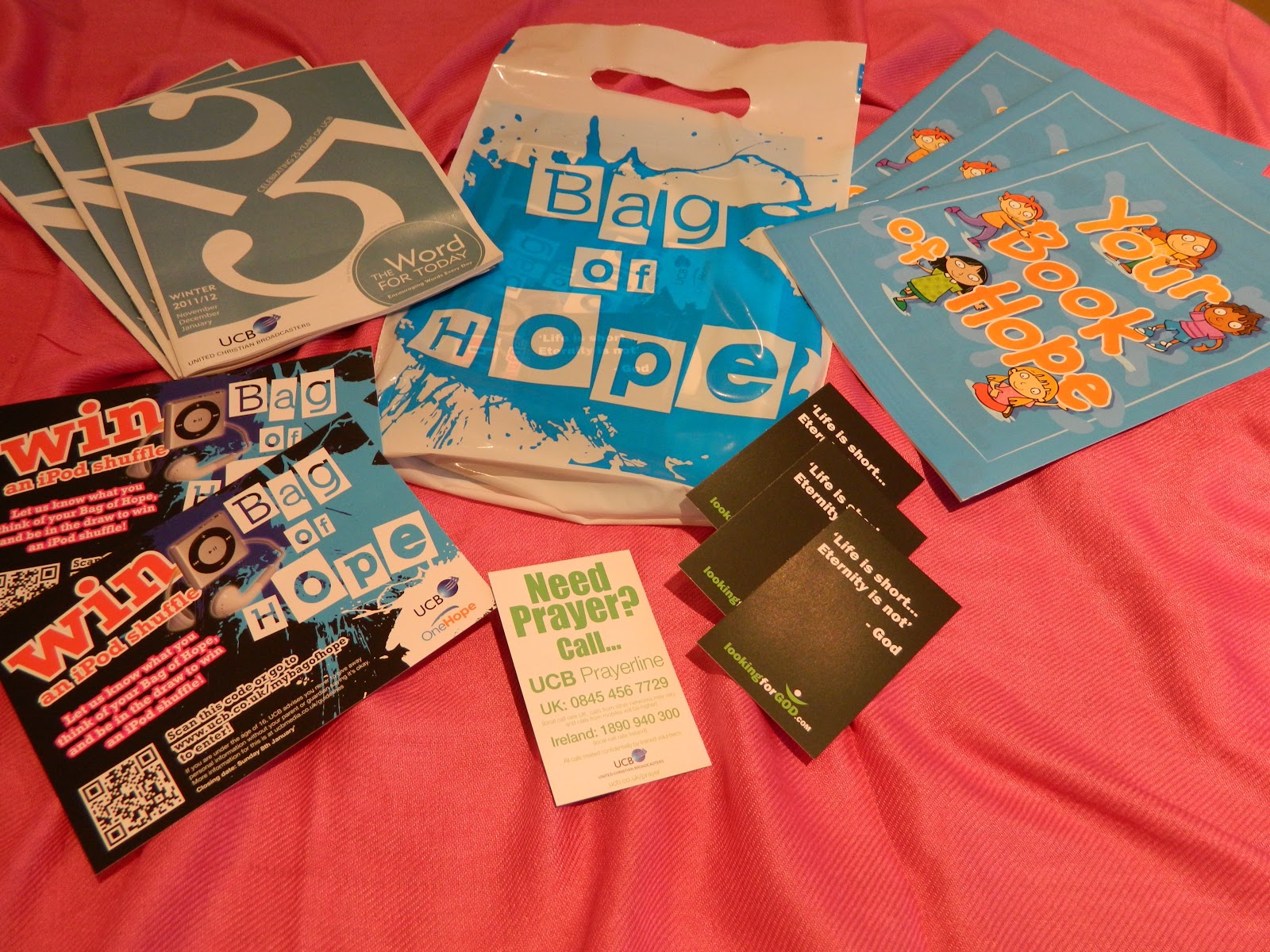
Contents of the Bag of Hope
I've always been a bit of a curmudgeon when it comes to Halloween. After all, it's the remnants of a pagan festival which had all-but died out in the UK, revived by a combination of imported US TV and Wal-Mart's acquisition of Asda ten years ago. There's no historical or cultural tradition in the UK for celebrating it the way we do today, and the lesson it gives the children about many subjects from spirituality through to stranger-danger is highly suspect.


My normal way of dealing with it is to try to ignore it - grudgingly give out sweets to those local kids who don't already know the lecture they're likely to get at our front door.

But that's not a very Christian attitude, so this year we've decided to do something positive.

A while back we heard UCB Radio advertising their 'Bag of Hope'. It's a collection of resources for both children and adults, in a handy bag to which you can add sweets or whatever else you decide. UCB send them out free (you pay the postage). Ours arrived last week.

So this year, the lucky first 20 groups of kids who ring our doorbell on October 31st will get:

  • 'Your book of hope' - a 32-page workbook which explains the story of Jesus for primary-school ages
  • The latest quarterly instalment of Bob Gass's 'The Word for Today' for the adults
  • A card promoting lookingforgod.com and the UCB Prayerline
  • A call to action by way of a URL promoting a prize draw and soliciting feedback
  • Some sweets and church contact details

Now I'm fairly sure we'll get some funny looks. Maybe even some bad reactions. But I see it like this - not only are we giving the kids the sweets they were expecting, but something which could turn out to be immeasurably more valuable.

What's the worst that could happen? We can wash eggs off the car. If just one kid reads through the workbook, does some of the puzzles and asks questions, it's been more than worthwhile. If just one parent looks through the Word for Today and wants to hear more, that's a major win.

Wednesday, 5 October 2011

Willow Creek comes to town


Our church, Kerith Community Church in Bracknell, turns into one of many satellites of Willow Creek this weekend as the Willow Creek Global Leadership Summit comes to town.

Not the real conference, of course – that was back in August and wasn’t without controversy – Starbucks CEO Howard Shultz was forced to step down from an engagement to speak because of an anti-gay protest – this is a video re-run over two days which is doing a world tour.

I’m a big fan of the Senior Pastor at Willow Creek, Bill Hybels. He is a consummate communicator, dedicated evangelist and an inspirational church leader. I’ve read a number of his books, and I particularly recommend ‘Holy Discontent’, which describes Bill’s view of how each of us can discern and answer our individual calling to make a difference in the world.

Willow Creek started the Leadership Summit series back in 1995 with a mission to inspire local church leaders to build on their leadership gifts. It’s now a worldwide event with over 100,000 attendees in over 70 countries. Which is quite some achievement.

I’m delighted that the GLS is coming to our church. And even more delighted that I have the chance to attend. With 2 days in church listening to inspirational leaders, both church and secular, who knows how God will speak to me – I just hope I’ll be ready to respond.  

Wednesday, 28 September 2011

A light read?

As if my reading list wasn’t already long enough, I recently volunteered to join two virtual reading groups. I find it very valuable to discuss texts as widely as possible – especially with groups of people who come to the subject from different perspectives.


My first assignment came from responding to a Google+ post from Sam Radford. His group at Mosaic Sheffield have just embarked on a study of Michael Lloyd’s ‘CafĂ© Theology’, which they’re going to be reading and discussing face-to-face at their bi-weekly meetings. I suggested I might read along with them, and Sam graciously agreed. I’m just through the first chapter and will be writing up some thoughts in the next few days. I’m really looking forward to hearing what the others in the group have to say.


The other project was started by Jeremy Myers who blogs at www.tillhecomes.org . It’s a Blogging Book Club – a synchronized reading/blogging exercise, explained in detail at Jeremy’s blog and Anthony Erhart’s blog. Other participants are more than welcome to join up – see Jeremy’s post for details. We’ll all read and blog as we go along, cross-referencing each others’ posts.

The first book we’re going to be reading is ‘The Theology of the Book of Revelation’ by Richard Bauckham. I’m really looking forward to getting stuck into this, as I’ve not studied Revelation in detail. I’ve been warned to expect controversy.


I hope others will dive in to read and comment - let us know if you want to get on the team.

Monday, 26 September 2011

That Monday feeling...

"It’s so unfair!”
(Please read in a Kevin the Teenager voice).

Aren’t Sundays wonderful? The anticipation of a restful day, a choice of three church services to attend, the children keen to go to their own activities. A feeling of peace and calm descends on the family. Our spiritual life is on full-throttle; the trials and tribulations of the past week have faded into distant memories. Sundays are Different. Sundays are Great. Sundays are for God and our relationship with him. Exodus 20:28 “Remember to observe the Sabbath day by keeping it holy”.

So why do Mondays have to come along and spoil things?

I’m lucky –God has blessed me with a job I enjoy. I’ve been a consultant in IT for the past 13 years, and have had the privilege of working with clients in a whole variety of businesses. My specialism is in Programme Delivery Assurance, and the client I’m currently working with has given me exposure to the transport sector, which is a whole new area for me. I think I’m pretty good at what I do (I must be, otherwise people wouldn’t hire me and re-hire me) and it’s not a chore. All in all, I feel blessed that I’m able to use the skills and experience God has given me in order to support my family and give back to him through the Church. I’m pretty well in tune with Colossians 3:22-25.

Getting to work, though, is the part I dislike enormously. Try as I may, I’m failing to see God’s glory on the 0719 to Waterloo, or on a crowded London Underground train. Today was extra-busy due to the wet weather, and I had the pleasure of someone’s armpit a few inches from my face most of the way. I reckon I’m just getting too old for the rat-race. Especially when it takes up nearly four hours a day, every day.

So today especially, I’m considering what changes are afoot. Whilst I can take occasional advantage of remote working with my current client, they’re not particularly keen (they’re a transport company, after all…). With God’s blessing, I hope to transition to a more amenable work pattern. I need to establish a network of clients for whom I can work mostly remotely, and gear myself up for full-time home working whilst remaining sensitive to everyone’s needs. This should free me from the rat-race, give me more time for the family and allow me to get more involved with Church and the community.

Whilst God is with me throughout the day whatever day of the week, I crave the space to be able to respond to him. These changes, with the support and prayers of those around me, will mean that Mondays can become less of a shock to the system and every day can be a bit more like Sunday.

Wednesday, 21 September 2011

Distractions


The little 4 x 2 inch box most of us carry around all day shouldn’t be called a mobile phone. It should be called a mobile distraction machine.

For a start, its predominant use these days isn’t to make phone calls. A glance around my train carriage of a morning proves that. 90% of the passengers are hunched over their little distraction machines. Some of them are communicating (by email or text message, perhaps), some are socialising (updating their Facebook status, sending a Tweet), and others are playing Angry Birds or some other game-of-the moment. Nobody is making a phone call.

And they’re all using the machine to distract themselves from the boredom of the train journey. 

The modern world is already full of distractions. But we buy and feed these little boxes to provide even more.

So is there any wonder, when Simon, our Pastor, was speaking last Sunday about how he was distracted from reading the Bible by emails, Facebook messages and Rugby scores, that he blames his distraction machine?

It’s not the machine’s fault. It’s ours. The machine has an ‘off’ button. You can leave it behind, and (here’s the revelation) it probably won’t matter. Your Facebook friends can wait a few hours for the latest bit of essential news about your life, and if you don’t find out until tomorrow that your sister-in-law’s son’s cousin’s relationship status has changed to It’s Complicated, the world won’t end. We buy these machines to provide us with distractions, and then complain when we’re distracted.

The footie scores won’t change if you wait to see them on the television or read them in the paper. Angry Birds will be just as Angry if you don’t play with them today. And if your virtual crops wither a bit, you can always plant some more.

Now I’m just as guilty. My distraction machine is sitting next to me as I type this, and if its light flashes at me I usually can’t wait to see what it’s got to tell me. But what I do know is that I’m in charge of it, not the other way round – the people at the other end that *really* need to get hold of me for something more important than telling me who got most drunk at a party (along with photographic evidence) still can even when I switch it off.

So back to the Pastor. He reads the Bible on his distraction machine. So do I, as a matter of fact – I have the YouVersion app which gives access to way more translations than I will ever read, allows searching, highlighting, sharing, access to reading plans and probably a load more things that I’ve never discovered. The companion website adds side-by-side parallel versions, too, which comes in very handy for study purposes (I’m doing a theology degree by distance learning). It’s a great piece of technology, there’s no doubt.

But is it right to bundle God's word along with all the distractions that our little box brings us? Is the Bible a distraction, competing for our attention with email, Facebook, games and sports results?

When it’s personal devotional time, or family fellowship time, I put away the distraction machine and reach for my trusty leather-bound NIV. It doesn’t tempt me to look at emails, check Facebook or read sports results. It doesn’t need charging, never crashes, the screen doesn’t freeze, and it never needs updating.

It presents God’s word in a simple, timeless, clutter-free way that lets me concentrate on the message, not the medium. And it allows me to feel much closer to God than I ever could with my distraction machine in my hand.

Photo (C) theOOBE on Flickr CC BY-NC-SA-2.0 Some Rights Reserved


Please feel free to comment below or join me on Google+ to carry on the conversation there. Follow this link to find the post there.